Cybersecurity News | October 27, 2026
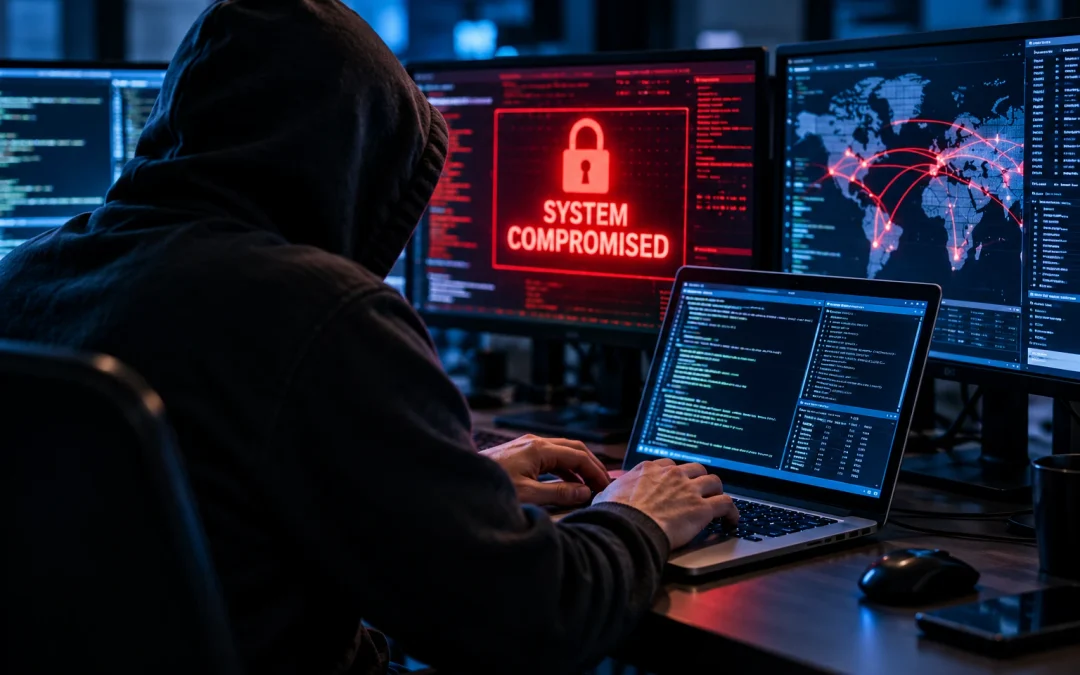
Imagine walking into your office on Monday morning.
Your employees are ready to start working, but something is wrong.
Someone cannot access the server. Another employee says their computer is not connecting. Your phone system is having problems, and now customers are waiting for answers.
You call your IT support company, but nobody is available to help right away.
Now what?
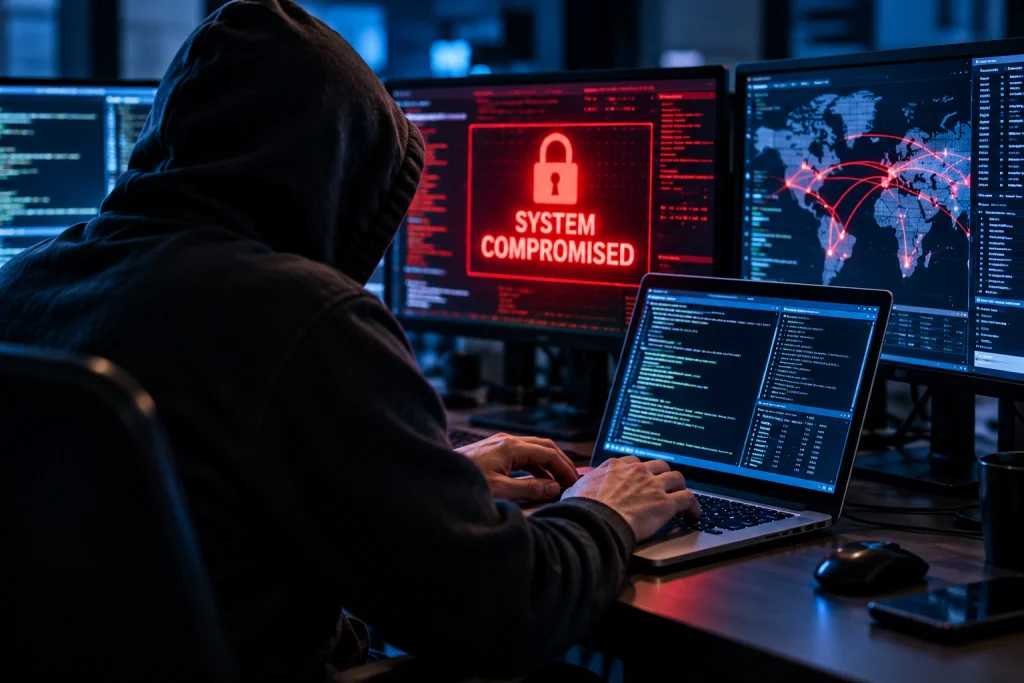
For many businesses, this would be a serious problem. But imagine something similar happening at a hospital where doctors, nurses, and patients depend on technology every day.
The UNM Health Cybersecurity Incident highlights the vulnerabilities that all organizations face in today’s digital landscape.
This incident serves as a wake-up call regarding the importance of cybersecurity at healthcare facilities and beyond.
That is why the recent UNM Health cybersecurity incident is so concerning.
It is also a reminder that cybersecurity is no longer something only large companies need to think about.
Small businesses need protection, too.
The impact of the UNM Health Cybersecurity Incident was felt across multiple departments, affecting both patient care and administrative operations.
What Happened at the University of New Mexico Hospital?
The attention given to the UNM Health Cybersecurity Incident reflects the growing concern over healthcare cybersecurity.
In the wake of the UNM Health Cybersecurity Incident, organizations are urged to rethink their cybersecurity strategies.
Lessons from the UNM Health Cybersecurity Incident include the need for robust IT protocols and rapid incident response plans.
On October 26, 2026, the University of New Mexico Health Sciences Center experienced a major cybersecurity incident that affected hospital services and other operations.
According to ABQ RAW, the incident caused serious disruptions across the health system.
UNM Health confirmed that ambulance traffic was temporarily diverted to other hospitals. Outpatient appointments and procedures were canceled, and some university classes were suspended.
The hospital's IT security teams began working to contain the incident and protect the network. State and federal law enforcement were notified, and outside partners were brought in to help investigate.
By the evening of October 26, UNM Health reported that both hospitals were open and that clinics would resume scheduled appointments the following day. Some academic operations remained closed.
The UNM Health Cybersecurity Incident serves as a critical case study for other healthcare providers to learn from.
The recent UNM Health Cybersecurity Incident is a reminder of the threats that all organizations face.
Understanding the UNM Health Cybersecurity Incident can help small businesses realize their vulnerabilities.
You can read the official UNM Health cybersecurity update.
The UNM Health Cybersecurity Incident should motivate businesses to evaluate their current cybersecurity measures.
As of October 27, the full cause of the incident had not been publicly confirmed.
We do not know which security weakness, if any, allowed an attacker into the systems. We also do not know whether patient information was stolen.
Those details matter because we should never assume how an attack happened before investigators have the facts.
But there is already an important lesson here.
When technology stops working, the impact can reach far beyond the computers themselves.
After the UNM Health Cybersecurity Incident, many companies are re-assessing their cybersecurity strategies.
Why Should a Small Business Care About a Hospital Cyberattack?
You might be thinking, "We are a small business in Ventura. Why would someone want to attack us?"
That is a good question.
The problem is that cybercriminals do not always care whether you have ten employees or ten thousand.
Sometimes attackers use automated tools to search for weak passwords, exposed systems, or software that has not been updated.
Moreover, the UNM Health Cybersecurity Incident exemplifies the evolving landscape of cybersecurity challenges.
They may target a small accounting office, a medical practice, a construction company, or a local retail business.
Your company may not have the same technology as a large hospital, but you still depend on computers, email, customer records, and business software.
If those systems stop working, how long could your employees continue doing their jobs?
That is why every business should have a cybersecurity plan.
What Is a Cybersecurity Security Stack?
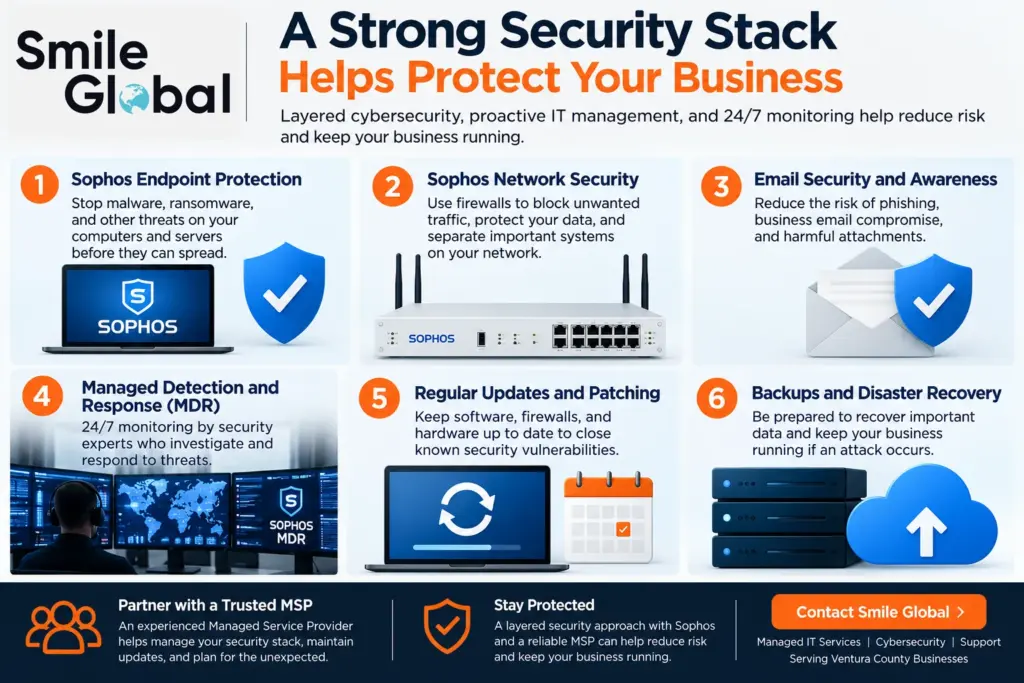
At Smile Global, we believe protecting a business requires more than installing antivirus software.
You need several layers of protection working together. IT professionals call this a security stack.
Think about securing your business building.
You have locks on the doors. You might have security cameras, an alarm system, and someone watching for suspicious activity.
Each protects you in a different way.
Your computer network needs a similar approach.
One security tool cannot protect every part of your business.
Ultimately, lessons from the UNM Health Cybersecurity Incident can inform better practices industry-wide.
We hope that the UNM Health Cybersecurity Incident prompts a re-evaluation of cybersecurity measures.
This is why we recommend looking at security solutions from Sophos, including endpoint protection, firewalls, email protection, and Managed Detection and Response.
In light of the UNM Health Cybersecurity Incident, healthcare facilities must prioritize cybersecurity training for their staff.
How Sophos Helps Protect a Small Business
Sophos provides several security products that can work together to protect business technology.
Sophos Endpoint helps protect computers and servers from malware, ransomware, and other harmful activity.
Sophos Firewall helps control network traffic and block unwanted connections. It can also help separate important business systems from other devices.
Sophos email security tools can add another layer of protection against harmful messages and attachments.
These tools can help reduce risk, but they still need to be configured, maintained, and monitored correctly.
For example, having an expensive firewall does not help much if nobody updates its firmware or reviews its security settings.
And having antivirus software does not mean every attack will automatically be stopped.
The technology matters, but so does the team managing it.
That brings us to something I believe is especially important for small businesses.
Why Your Business Needs a 24/7 MDR Team
MDR stands for Managed Detection and Response.
Now, what does that mean?
Imagine someone tries to access your company network at two o'clock in the morning.
Your employees are home. Your office is closed. Nobody is sitting at a computer watching security alerts.
What happens if something suspicious starts taking place?
This is where a 24/7 MDR service can make a big difference.
Sophos MDR combines security technology with a team of specialists who monitor, investigate, and respond to threats around the clock.
They look for unusual activity that may indicate someone is trying to compromise your systems.
If they identify a serious threat, they can investigate and take actions allowed by your service plan and response settings.
For example, they may help contain an infected computer so an attack is less likely to spread.
Sophos has different MDR service levels. Its standard MDR service includes threat containment and guidance, while MDR Plus includes more complete incident response.
This is important because a business should understand exactly what its security provider will do during an emergency.
Reflecting on the UNM Health Cybersecurity Incident, it’s clear that preparedness is key for all organizations.
In conclusion, the UNM Health Cybersecurity Incident underscores the need for vigilance in cybersecurity.
You can learn more about Sophos Managed Detection and Response.
Why an MSP Is Just as Important as Your Security Software
Now let's talk about the people taking care of your technology.
An MSP, or Managed Service Provider, is a company that helps manage and maintain your business IT systems.
At Smile Global, we believe a good MSP should do more than wait for a customer to call with a problem.
Your IT team should know what equipment you have, which systems are important, and what needs attention.
For example, are your servers running supported operating systems?
Are your network switches and firewalls receiving security updates?
Does someone know when your equipment will reach the end of its supported life?
These are things that should be reviewed regularly.
Your MSP can also work with your MDR provider to coordinate security alerts, investigate problems, and carry out the steps needed to protect your business.
Assessments post-incident, like the UNM Health Cybersecurity Incident, are crucial for improving future defenses.
The MDR specialists monitor and respond to threats according to their service agreement. Your MSP helps manage the equipment, updates, access, recovery planning, and ongoing support.
Both teams should know who is responsible for each part of an incident.
Outdated Hardware Can Become a Security Risk
Here is something that often gets overlooked.
Some businesses continue using firewalls, network switches, and servers long after the equipment manufacturer has stopped providing security updates.
The equipment may still turn on.
It may still connect to the internet.
Ultimately, every business can benefit from the lessons learned in the UNM Health Cybersecurity Incident.
Everything may look perfectly normal.
Thus, the UNM Health Cybersecurity Incident serves as a pressing illustration of current cybersecurity threats.
But that does not mean it is safe.
When a manufacturer stops supporting a device, important security problems may no longer receive fixes.
This can leave a business exposed to known weaknesses that attackers may try to exploit.
That is why an MSP should maintain a record of your equipment and help plan replacements before support ends.
It does not mean you need to purchase new equipment every year.
It means knowing what is safe to keep, what needs updating, and what should be replaced.
Security Patches Should Never Be Ignored
A security patch is an update that fixes a problem in software or firmware.
Think about finding out that one of the locks on your office doors has a known weakness.
Organizations should learn from the UNM Health Cybersecurity Incident to enhance their security frameworks.
Would you leave it that way for another year?
Probably not.
Computer software and network equipment need the same attention.
An MSP should review important security updates, determine which systems are affected, and schedule patches based on risk.
Critical problems may require urgent action. Other updates can be installed during planned maintenance windows after compatibility checks.
A good patching process also includes testing and a way to recover if an update causes a problem.
This is one reason we recommend proactive maintenance instead of waiting until something breaks.
Let's Go Back to That Monday Morning
Remember the small business we talked about at the beginning?
Employees could not access their files. Phones were having problems. Customers were waiting.
Now imagine that same business has a managed firewall, protected computers, monitored servers, and an MDR team watching for threats.
The business also has an MSP that knows the network, keeps security patches current, and has a clear response plan.
If a security alert appears, the right people know who to contact and what actions are authorized.
That does not mean an attack cannot happen.
But it gives the business more ways to detect a problem, limit damage, and recover.
That is the difference between simply buying security software and building a cybersecurity plan.
Don't Forget Backups and Disaster Recovery
Even with strong cybersecurity, businesses need to prepare for the possibility that an attack gets through.
What happens if ransomware locks your files?
What happens if a server fails during the incident?
Can your company recover its important data?
A good backup plan should include protected copies of your data, preferably with a separate offsite copy that attackers cannot easily change or delete.
Your backups also need regular testing.
A successful backup report does not always mean your entire server can be restored when needed.
A disaster recovery plan explains how systems will be brought back and which services are most important.
Learn more about Backup and Disaster Recovery at Smile Global.
Cybersecurity Best Practices for Small Businesses
Here are a few things I recommend every business review.
- Build protection in layers. Use appropriate endpoint protection, firewall security, account protection, backups, and monitored threat detection.
- Keep systems maintained. Have an MSP review software patches, firmware updates, hardware support dates, and security settings.
- Prepare for an incident. Know who your MDR team and MSP contacts are, what they can do during an attack, and how your business will recover important systems.
These are practical steps that can help reduce risk without requiring a small company to build its own full IT security department.
Frequently Asked Questions About Managed Cybersecurity
What is the difference between antivirus and MDR?
Antivirus software helps detect and block harmful files and activity. MDR goes further by combining security tools with specialists who monitor, investigate, and respond to threats. Both can play important roles in a cybersecurity plan.
Thus, the UNM Health Cybersecurity Incident should resonate with every business's cybersecurity strategy.
The UNM Health Cybersecurity Incident is a learning opportunity for all sectors, particularly healthcare.
In conclusion, the UNM Health Cybersecurity Incident emphasizes the necessity for strategic security planning.
Security practices must evolve in response to incidents like the UNM Health Cybersecurity Incident.
As we reflect on the UNM Health Cybersecurity Incident, we are reminded of the threats we all face.
In short, the UNM Health Cybersecurity Incident must motivate businesses to improve their cybersecurity measures.
We all have a role in preventing incidents like the UNM Health Cybersecurity Incident.
Does a small business really need Sophos MDR?
A small business can benefit from MDR, especially when it does not have employees watching security alerts around the clock. The right level of protection depends on the company's risk, budget, and business needs.
Can Sophos stop every cyberattack?
No security product can guarantee that every attack will be stopped. Sophos tools can help prevent, detect, and respond to threats, but they work best alongside good security practices, regular updates, and reliable backups.
Why should I hire an MSP if I already have security software?
Security software still needs to be installed, managed, updated, and reviewed. An MSP can help maintain your computers, servers, firewalls, and other equipment while coordinating with your MDR provider when serious threats occur.
How often should network equipment receive security updates?
There is no single schedule that fits every device. Critical security fixes may require immediate attention, while other updates can be scheduled during maintenance. Your MSP should monitor manufacturer advisories and review equipment regularly.
What should I do if I think my business has been attacked?
Contact your IT provider or incident response team immediately. Avoid making random changes that could interfere with the investigation. Follow your response plan, protect affected systems, and determine whether important data or services are at risk.
The Real Lesson From the UNM Health Cybersecurity Incident
Let's return one last time to that Monday morning.
Your employees are ready to work, but the systems they depend on are unavailable.
Now the business owner has a choice.
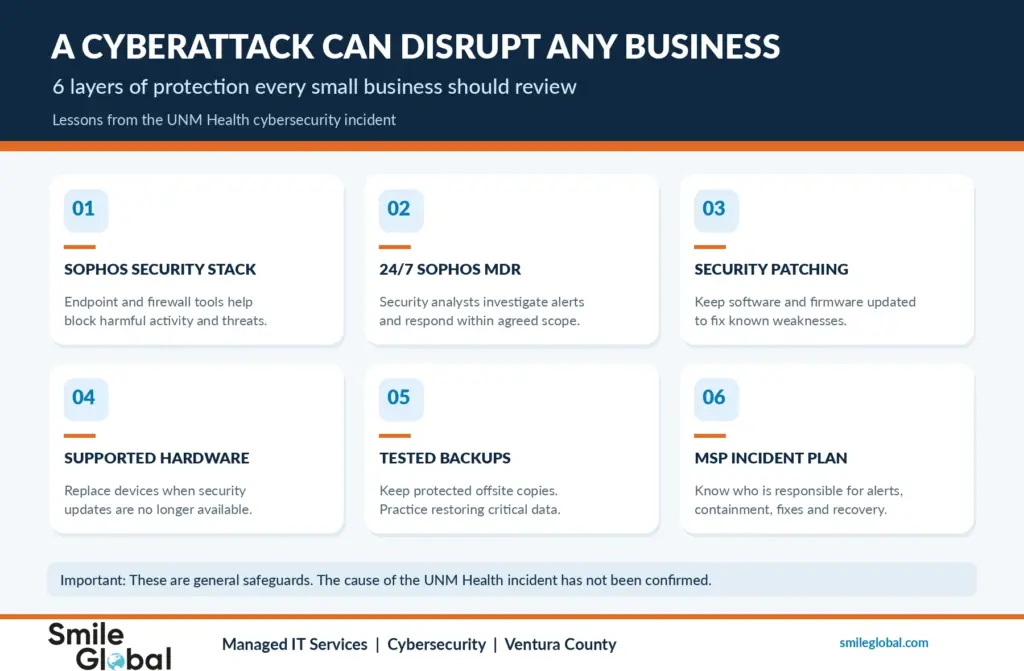
Do they start calling around trying to find someone who understands their network?
Or do they already have an IT partner, security monitoring, and a recovery plan in place?
That is what I want business owners to think about when they read news about major cyber incidents.
We do not know exactly how the University of New Mexico incident began, and it would be wrong to assume that a particular product or update would have prevented it.
But the disruption shows how important technology has become to everyday operations.
Smile Global, we help small and growing businesses throughout Ventura County strengthen their cybersecurity, manage their IT systems, maintain network equipment, and prepare for unexpected problems.
We believe businesses should understand the protection they have, the protection they may be missing, and what happens when something goes wrong.
You do not need to be a technology expert to run a successful business.
But you do need someone who understands your technology and knows how to help protect it.
Learn more about our Cybersecurity Services and Managed IT Services in Ventura.
Smile Global
IT problems, call Smile before you lose yours.
805-918-0508
Table of Contents
Frequently Asked Questions About Cybersecurity
Protect Your Business Before Something Goes Wrong
The UNM Health cybersecurity incident is a reminder that technology problems can interrupt even large organizations.
At Smile Global, we believe small businesses deserve strong cybersecurity protection, too.
Our goal is to help Ventura County businesses understand their security risks, maintain their technology, and prepare for the unexpected.
Learn more about our Cybersecurity Services and Managed IT Services in Ventura.
Smile Global
IT problems, call Smile before you lose yours.